A strong core isn’t about six-pack abs — it’s the foundation that keeps your spine safe, your posture upright, and your daily life pain-free.
Mark, 52, had lived with low-grade lower back pain for years. He’d tried stretching, switching office chairs, and even a new mattress. Nothing seemed to stick. It wasn’t until his physical therapist prescribed a structured core training program that the pain finally began to ease — and he started moving with a confidence he hadn’t felt in a decade.
His story is far from unusual. According to the NIH, approximately 80% of Americans will experience back pain at some point in their lives, and it remains one of the leading causes of disability in adults aged 40 and older. What most people don’t realize is that the root cause is often not the spine itself — it’s the muscles surrounding it.
In this guide, you’ll learn exactly what core training means for adults over 40, why it’s different from what you did in your 20s, which exercises are most effective and safest, and how to build a routine that reduces back pain, improves posture, and helps you move better in everyday life.
What Is Core Training — And Why Does It Change After 40?
When most people hear "core," they picture crunches and a flat stomach. But your core is actually a complex group of muscles that wraps around your entire midsection — front, sides, and back. It includes the rectus abdominis (the front ab muscles), the transverse abdominis (deep stabilizing muscle), the obliques (side muscles), the multifidus (deep spinal muscles), the pelvic floor, and the diaphragm.
Together, these muscles form what clinicians call your "natural corset" — a cylinder of support that stabilizes your spine during every movement you make, from picking up groceries to reaching overhead.
After 40, several physiological changes make core training both more challenging and more essential. Sarcopenia — the age-related loss of muscle mass — begins as early as your 30s and accelerates with each decade. Research published in the Journal of Cachexia, Sarcopenia and Muscle estimates that adults lose between 3% and 8% of muscle mass per decade after age 30, with that rate increasing after 60.
Core muscles are not exempt from this decline. As deep stabilizers weaken, the spine becomes less supported, postural alignment shifts, and movements that were once effortless — bending, rotating, lifting — become sources of pain or injury risk. Core training after 40 isn’t about aesthetics. It’s about preserving function.
Signs Your Core May Be Weak
You don’t need a fitness test to recognize the early warning signs of core weakness. Many of them show up in everyday life:
- Persistent lower back pain, especially after sitting or standing for extended periods
- Poor posture — rounding of the shoulders, forward head position, or an exaggerated lower back curve
- Balance problems or difficulty standing on one leg without wobbling
- Pain or discomfort when transitioning from sitting to standing
- Difficulty performing overhead activities like reaching into high cabinets
- Fatigue in the lower back after short walks or light activity
- Abdominal "coning" or doming during exertion, which may indicate core dysfunction
A 2021 meta-analysis in the Journal of Physical Therapy Science found a significant association between core muscle weakness and chronic low back pain in adults, particularly in those who lead sedentary lifestyles — a growing concern for the desk-bound workforce aged 40 to 65.
If you’re experiencing severe or radiating back pain, numbness in your legs, or loss of bladder control, these are red flags requiring immediate medical evaluation — not a core workout. We’ll address those warning signs in more detail below.
Why Core Training Is Different After 40
Core training in your 40s, 50s, and 60s must be approached with a different mindset than what popular fitness culture promotes. High-impact movements, aggressive spinal flexion (like traditional sit-ups), and breath-holding under load can all increase injury risk in this age group.
The goal shifts from performance to stability and function. Here’s what clinical evidence tells us matters most:
1. Deep muscle activation over superficial crunching. The transverse abdominis — your deepest abdominal muscle — is the primary spinal stabilizer. Most traditional ab exercises don’t effectively target it. Exercises like the dead bug, bird-dog, and plank progressions activate this muscle more efficiently, according to research from the American Council on Exercise.
2. Anti-movement before movement. Clinical rehabilitation specialists often emphasize "anti-movement" core training — teaching your core to resist unwanted motion rather than create it. Exercises like the Pallof press, side planks, and suitcase carries train this stability pattern and have strong evidence for reducing lower back pain.
3. Breathing mechanics matter. Intra-abdominal pressure — the internal support system of your spine — depends on coordinated breathing. Learning to exhale on exertion and avoid breath-holding is critical for protecting spinal discs during exercise, especially after 40 when disc hydration naturally decreases.
If you’re also working on overall movement quality, our guide on Flexibility & Mobility Training for Adults 40+ covers complementary strategies that pair well with core work.
The Most Effective Core Exercises for Adults Over 40
The following exercises are widely recommended by physical therapists and certified strength and conditioning specialists for adults in this age group. Always begin with the foundational movements before progressing to more challenging variations.
Foundation Level (Weeks 1–4)
Diaphragmatic Breathing. Lie on your back with knees bent. Inhale through your nose, letting your belly rise (not your chest). Exhale slowly through pursed lips. This resets your breathing pattern and activates the deep core. Practice 5–10 breaths daily.
Dead Bug. Lie on your back, arms reaching toward the ceiling, knees bent at 90 degrees (tabletop position). Slowly lower your right arm and left leg toward the floor while keeping your lower back pressed flat. Return and alternate. This activates the transverse abdominis without stressing the lumbar spine.
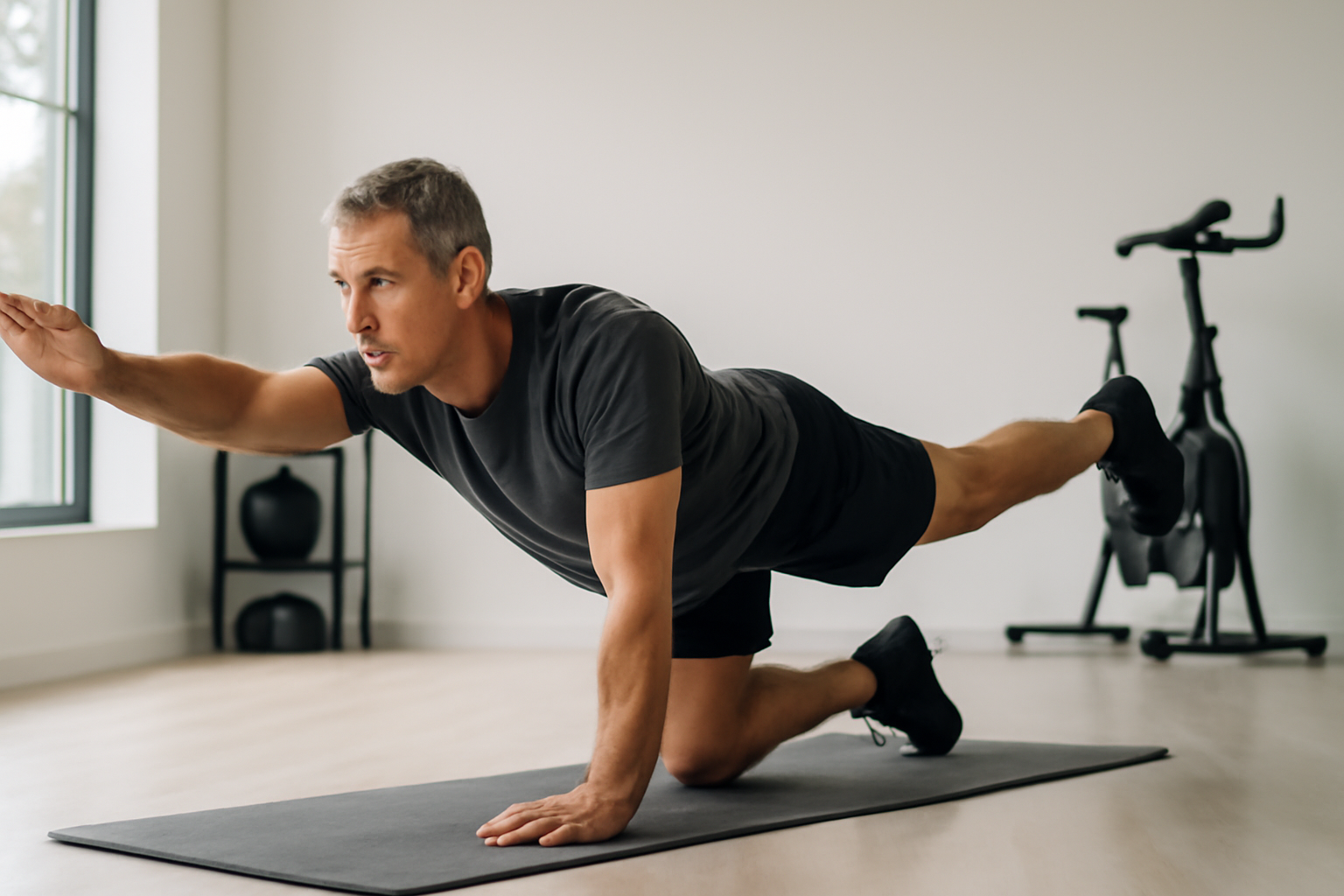
Bird-Dog. Start on hands and knees, spine neutral. Extend your right arm and left leg simultaneously, hold for 3–5 seconds, and return. This trains spinal extension stability and is consistently cited in physical therapy literature as a foundational low-back rehabilitation exercise.
Glute Bridge. Lie on your back with knees bent and feet flat. Press through your heels to lift your hips, squeezing your glutes at the top. The glutes are a critical component of posterior core stability — neglecting them is one of the most common gaps in core training programs.
Intermediate Level (Weeks 5–10)
Forearm Plank. Hold a forearm plank with your body in a straight line from head to heels. Focus on keeping your hips level and your lower back from sagging. Research from McGill University — led by Dr. Stuart McGill, one of the world’s leading spine biomechanics researchers — supports the plank as a superior spinal-neutral core exercise compared to sit-ups or crunches.
Side Plank. Lie on your side and prop yourself up on your forearm, forming a diagonal line. This trains the lateral core and quadratus lumborum — a muscle frequently implicated in lower back pain. Start with 15–20 second holds and progress gradually.
Pallof Press. Using a resistance band anchored at chest height, hold the band at your sternum and press it straight out in front of you, resisting the rotational pull. This anti-rotation exercise is highly effective for building functional core stability.
Suitcase Carry. Hold a moderate weight (dumbbell or kettlebell) in one hand and walk in a straight line for 20–30 steps, keeping your torso completely upright. Switch sides. This functional movement trains anti-lateral flexion and mirrors real-life demands like carrying bags.
Advanced Level (After 10 Weeks of Consistent Training)
Single-Leg Deadlift (bodyweight or light load). Hinging at the hip on one leg trains posterior chain strength and hip-to-core coordination — a key injury prevention pattern for adults over 40.
Cable or Band Chop/Lift. Diagonal pulling patterns that train rotational core strength in a controlled, safe range. These movements closely replicate how the core must work during daily life activities like getting in and out of cars or carrying children or grandchildren.
For additional movement options that complement your core program, our guide on Low-Impact Exercise After 50: Best Workouts for Joints offers practical alternatives for those managing joint sensitivity.
How to Build a Core Training Routine That Sticks
Consistency matters far more than intensity. Clinical evidence consistently shows that even two to three focused core training sessions per week produce measurable improvements in spinal stability, pain reduction, and functional movement — particularly in adults over 40.
Here’s a realistic framework:
- Frequency: 2–3 days per week, with at least one rest day between sessions
- Duration: 15–25 minutes of focused core work is sufficient; it doesn’t require a full gym session
- Progression: Add difficulty every 2–3 weeks by increasing hold times, reps, or resistance — not by adding pain
- Warm-up: Always begin with 5 minutes of light movement and diaphragmatic breathing before core exercises
- Rest: Core muscles need recovery just like any other muscle group. Avoid daily intense core sessions
A 2022 systematic review in the British Journal of Sports Medicine found that structured core stabilization programs performed 2–3 times per week for 8 or more weeks significantly reduced chronic low back pain and improved functional disability scores in adults aged 40 to 65.
Pairing core training with regular walking is one of the most underrated combinations for spinal health. Learn how to structure your walking routine in our guide: Walking for Fitness After 50: Benefits and How to Start.
Core Training and Back Pain: What the Evidence Actually Says
It’s worth being precise here: core training is not a guaranteed cure for all types of back pain. Back pain has many causes — disc herniation, spinal stenosis, arthritis, nerve compression, and others — and some require specific medical treatment. What research does consistently support is that core stabilization training is among the most effective conservative (non-surgical) interventions for non-specific chronic low back pain, which accounts for approximately 85% of all back pain cases, according to the American Family Physician.
The American College of Physicians currently recommends exercise therapy — including core stabilization — as a first-line treatment for chronic low back pain before considering medication in most cases. This represents a significant shift in clinical thinking and underscores how central movement is to spinal health management.
That said, always work with your physician or a licensed physical therapist to identify the specific source of your back pain before starting any exercise program. This varies from person to person, and what helps one individual may be contraindicated for another with a different underlying cause.
When to See Your Doctor: Red Flags You Shouldn’t Ignore
Core training is appropriate for most adults over 40, but certain symptoms should prompt you to seek medical evaluation before beginning or continuing exercise:
- Back pain that radiates down one or both legs (sciatica or possible nerve compression)
- Numbness, tingling, or weakness in the legs or feet
- Loss of bladder or bowel control — this is a medical emergency requiring immediate care
- Back pain following a fall or injury
- Pain that is severe, constant, or worsening despite rest
- Night pain that wakes you from sleep without a positional cause
- Unexplained weight loss accompanying back pain
At your next routine appointment, consider telling your doctor: "I’ve been experiencing lower back pain and want to start a core strengthening program. Are there any restrictions I should be aware of given my medical history?" This gives your provider the opportunity to guide you safely.
Frequently Asked Questions
Is it safe to do core exercises every day after 40?
Most clinical guidelines recommend 2–3 days per week for structured core training, allowing adequate muscle recovery between sessions. Light activities like diaphragmatic breathing and walking can be done daily. Overtraining without recovery can actually increase injury risk, particularly in connective tissue that becomes less elastic with age.
Are sit-ups and crunches bad for adults over 40?
Research from spinal biomechanics experts, including Dr. Stuart McGill at the University of Waterloo, suggests that repeated spinal flexion under load — as occurs with traditional sit-ups — can increase compressive force on lumbar discs. For most adults over 40, particularly those with any history of back issues, spine-neutral exercises like planks and dead bugs are safer and more functionally effective alternatives.
How long before I notice results from core training?
Research suggests that most people notice meaningful improvements in pain levels and movement quality within 6–8 weeks of consistent core training. Structural changes in muscle strength and coordination may take 10–12 weeks. This varies from person to person depending on starting fitness level, consistency, and any underlying conditions.
Can core training help with posture?
Clinical evidence strongly supports the relationship between core strength and posture. A stronger transverse abdominis and multifidus provide the support needed to maintain a neutral spine alignment during prolonged sitting and standing — both of which are major contributors to postural breakdown in adults who work desk jobs.
Do I need equipment or a gym to train my core after 40?
No. The most evidence-supported core exercises for adults over 40 — dead bugs, bird-dogs, glute bridges, and planks — require no equipment whatsoever. A resistance band (under $15) expands your options significantly. A gym is optional; consistency is not.
Conclusion
Core training after 40 isn’t about looking a certain way — it’s about moving with confidence, reducing pain, and protecting your body for the decades ahead. The science is clear: a structured, intelligent core program can meaningfully reduce low back pain, improve posture, and support the kind of functional independence that makes daily life richer.
You don’t need complicated equipment or hours at the gym. You need consistency, sound technique, and a program built for how your body actually works at this stage of life. Start where you are, progress gradually, and partner with your healthcare provider to ensure your approach is tailored to your specific needs.
Stronger from the inside out — that’s what core training over 40 can do for you.
Medical Disclaimer: This article is for informational and educational purposes only. It does not constitute medical advice, diagnosis, or treatment. Always consult your physician or a qualified healthcare provider before making changes to your health routine or treatment plan.
Medically reviewed by our editorial health team. Content follows evidence-based standards aligned with CDC and NIH guidelines.