Bodyweight Squat Progressions for Adults Over 40
Squatting is one of the most fundamental human movements — and after 40, mastering it progressively can protect your knees, strengthen your hips, and keep you independent for decades.
Margaret, 54, had been avoiding squats for years. After a knee injury in her mid-forties, her physical therapist told her that squatting was not off-limits — it just needed to be relearned the right way. Within four months of following a progressive bodyweight squat program, she was climbing stairs without pain, getting up from chairs with ease, and feeling more confident in her body than she had in a decade.
Her experience is far from unusual. According to the National Institutes of Health, age-related muscle loss — known as sarcopenia — begins as early as age 30 and accelerates significantly after 50, affecting an estimated 10 to 25 percent of adults over 60. The squat pattern, which engages the quadriceps, glutes, hamstrings, and core simultaneously, is one of the most efficient tools available to fight that decline.
If you are an adult over 40 wondering whether bodyweight squats are safe, effective, and worth your time, the answer — based on a growing body of clinical evidence — is a clear yes. This guide will walk you through the benefits, the correct technique, and a structured set of progressions designed to meet you exactly where you are, from beginner to advanced.
What Are Bodyweight Squat Progressions — and Why Do They Matter After 40?
A bodyweight squat progression is a structured sequence of squat variations, arranged from easiest to most challenging, that allows your body to build strength, mobility, and coordination gradually and safely — without adding external load like barbells or dumbbells.
The squat itself is classified as a compound movement, meaning it recruits multiple large muscle groups at once. According to the American College of Sports Medicine, compound lower-body exercises are among the most effective interventions for preserving functional mobility and reducing fall risk in adults over 40.
After 40, several physiological changes make progressive training especially important:
- Reduced joint cartilage resilience — making abrupt load increases more likely to cause irritation
- Slower neuromuscular recruitment — meaning the body takes longer to activate stabilizing muscles
- Decreased tendon elasticity — which increases injury risk when movement patterns are poor
- Lower baseline muscle mass — requiring deliberate training stimulus to maintain and rebuild strength
A well-designed progression addresses all of these factors by introducing movement complexity and demand incrementally, allowing tissue adaptation to keep pace with your training load.
Health Benefits of Squatting Regularly After 40
The evidence supporting regular squat training for adults over 40 is substantial and spans multiple areas of health.
A 2022 meta-analysis published in the Journal of Strength and Conditioning Research found that lower-body resistance exercise — including bodyweight squat variations — significantly improved functional mobility, balance, and muscle strength in adults aged 50 and older, with effects comparable to moderate-load resistance training when performed consistently.
Key benefits include:
- Improved leg strength and muscle mass — directly counteracting sarcopenia
- Better balance and coordination — reducing fall risk, which the CDC identifies as a leading cause of injury-related death among adults over 65
- Knee joint health — contrary to common belief, proper squatting strengthens the muscles that support and protect the knee
- Hip mobility preservation — maintaining the range of motion needed for daily activities like sitting, rising, and climbing stairs
- Metabolic benefits — engaging large muscle groups burns more calories and supports healthy blood sugar regulation, relevant to the 38 million Americans managing diabetes, according to the CDC
- Bone density support — mechanical loading through squat movements stimulates osteoblast activity, helping offset osteoporosis risk
Research from the National Institute on Aging also indicates that adults who maintain lower-body strength are significantly more likely to live independently in later years — a finding that makes squat training one of the most practical long-term health investments available.
Squat Technique: The Non-Negotiable Foundation
Before progressing to any variation, you need to understand and practice correct squat mechanics. Poor technique is the most common cause of knee and lower back discomfort during squatting, and most of it is entirely correctable.
The foundational squat checklist:
- Feet position: Shoulder-width apart, toes pointed slightly outward (10 to 30 degrees, depending on hip anatomy)
- Spine: Neutral — not excessively arched or rounded. Think tall chest, not bent-forward torso
- Knees: Track in line with your second and third toes — never collapsing inward
- Depth: Lower as far as your mobility comfortably allows. Parallel or below parallel is ideal, but not at the expense of form
- Weight distribution: Even across the entire foot — heel, midfoot, and ball of the foot all in contact with the floor
- Hips: Push back and down simultaneously, not just down
- Core engagement: Brace your abdominal muscles gently throughout the movement
This varies from person to person based on hip socket depth, femur length, and ankle mobility. Working with a certified personal trainer or physical therapist for at least one session to check your form is strongly recommended before progressing.
The Bodyweight Squat Progression: Level by Level
The following four-level progression is designed for adults over 40 who may be starting from a limited baseline or returning from a period of inactivity. Move to the next level only when you can complete the current one with consistently good form and no pain.
Level 1 — Chair-Assisted Squat (Weeks 1–3)
This is the ideal starting point if you have knee discomfort, balance concerns, or have not trained in a while.
How to do it: Stand in front of a sturdy chair. Perform a squat as described above, lowering yourself until your glutes lightly touch the seat — but do not fully sit. Then press through your heels to stand back up. Use your arms on a wall or the back of the chair only if needed for balance.
Target: 3 sets of 8 to 12 repetitions, 3 times per week. Rest 60 to 90 seconds between sets.
Why it works: The chair provides a depth limit and a psychological safety net, removing the fear of falling while training the correct movement pattern. Clinical evidence from the Mayo Clinic supports chair-assisted squats as an effective rehabilitation tool for knee and hip conditions.
Level 2 — Bodyweight Box Squat (Weeks 4–6)
Once you can perform 12 controlled reps from the chair with no pain, graduate to the box squat, which removes the chair contact but retains the depth guidance.
How to do it: Use a low box, step, or bench positioned behind you. Squat down until your glutes hover just above the surface — pause for one second — then drive back up without sitting fully. The key is controlled descent and a deliberate pause.
Target: 3 sets of 10 to 15 repetitions, 3 times per week.
Why it works: The pause eliminates the elastic rebound that allows poor technique to go unnoticed. It also increases time under tension, which clinical research suggests is an important driver of muscular adaptation in older adults.
Level 3 — Full Bodyweight Squat (Weeks 7–10)
This is the standard squat performed to full depth without any support or surface contact.
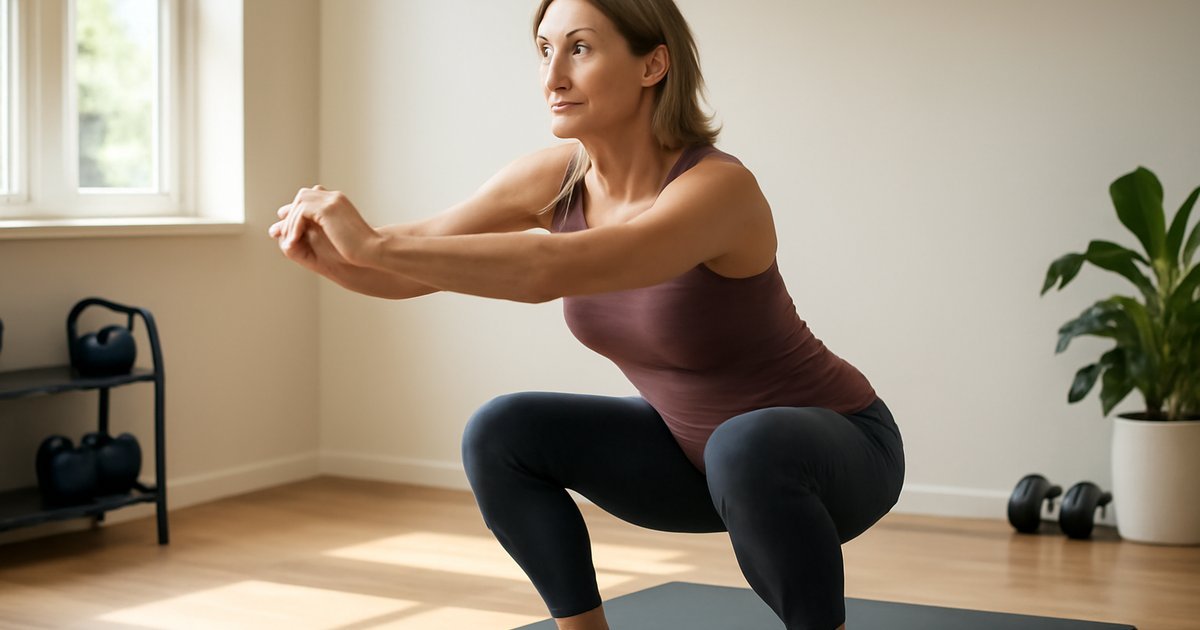
How to do it: Perform a controlled squat to your maximum comfortable depth, pause briefly at the bottom, and return to standing. Arms can reach forward for counterbalance. Keep your chest tall and your knees tracking outward.
Target: 3 sets of 12 to 20 repetitions, 3 to 4 times per week. Begin incorporating tempo work — a 3-second descent, 1-second pause, 1-second rise.
Progression tip: If ankle tightness limits your depth, place a small wedge or weight plate under your heels temporarily while you work on ankle mobility separately. Foam rolling your calves before squatting can also help — as detailed in resources on foam rolling after 40 for recovery and mobility.
Level 4 — Advanced Variations (Weeks 11 and Beyond)
Once you have mastered the full bodyweight squat with 20 clean repetitions, you are ready for more demanding variations.
- Sumo squat: Wider stance with toes pointed further out, placing greater emphasis on the inner thighs and glutes
- Pulse squat: Hold the bottom position and perform small rhythmic pulses to increase time under tension and glute activation
- Single-leg squat to chair (pistol progression): Perform a chair-assisted squat on one leg, building unilateral strength and balance
- Jump squat (low impact): For those without joint concerns, a controlled squat with a gentle heel raise at the top adds power training — important for fall prevention. Keep landings soft and quiet
- Split squat: A lunge-like position that challenges each leg independently while reducing spinal compression compared to heavy barbell work
These advanced variations pair particularly well with other training tools. If you are already using resistance bands or cable machines, those articles on cable machine workouts after 40 offer excellent complementary lower-body programming.
Building Your Weekly Squat Routine
Consistency and recovery are equally important after 40. Muscle protein synthesis — the process by which your body repairs and builds muscle — takes longer than it did at 25, according to research from the NIH’s National Institute on Aging.
Recommended weekly structure:
- Squat sessions per week: 2 to 4, depending on your level and recovery capacity
- Rest between squat sessions: At least 48 hours for lower-body recovery
- Warm-up (5 to 10 minutes): Hip circles, ankle rotations, bodyweight lunges, and gentle calf stretches before every session
- Cool-down (5 minutes): Static quad and hip flexor stretches, held 20 to 30 seconds each
Sample weekly plan for Level 2 to 3 adults:
- Monday: Box squat — 3 sets x 12 reps + hip flexibility work
- Wednesday: Full bodyweight squat — 3 sets x 15 reps, tempo focus
- Friday: Sumo squat + pulse squat superset — 3 rounds
- Saturday or Sunday: Active recovery — walking, stretching, or light yoga
This schedule aligns with the American College of Sports Medicine’s recommendation of at least two resistance training sessions per week for adults, targeting all major muscle groups.
Common Mistakes Adults Over 40 Make — and How to Avoid Them
Even well-intentioned exercisers can develop habits that slow progress or cause discomfort. Here are the most common squat errors seen in adults over 40:
- Progressing too quickly: Moving to heavier or more complex variations before the current level is solid is the leading cause of overuse injuries. Patience is a training virtue, not a weakness.
- Neglecting ankle mobility: Limited ankle dorsiflexion (the ability to flex your foot upward) forces your heels to rise, shifting load onto your knees. Daily calf stretching significantly reduces this problem.
- Shallow squatting to avoid discomfort: While pain is always a reason to stop, mild tightness at the bottom of a squat often improves with consistent, carefully dosed practice. Squatting only to 30 percent depth limits the training benefit considerably.
- Ignoring single-leg work: Most daily activities — climbing stairs, stepping off a curb — are performed on one leg at a time. Including unilateral variations is essential for real-world strength transfer.
- Skipping recovery: Adults over 40 who train hard every day without rest frequently plateau or develop chronic soreness. Structured rest days are not optional — they are where adaptation occurs.
When to Call Your Doctor or Physical Therapist
While bodyweight squatting is broadly safe for most adults, there are important red flags that require professional evaluation before or during any squat program.
See your doctor before starting if you have:
- A recent knee, hip, or ankle injury or surgery
- Diagnosed osteoporosis with fracture history
- Severe joint pain during any weight-bearing activity
- Uncontrolled hypertension or recent cardiac events
- Balance disorders or vestibular conditions
Stop and seek evaluation if you experience:
- Sharp, stabbing knee pain during or after squatting
- Swelling or locking of the knee joint
- New lower back pain radiating down your leg
- Hip clicking accompanied by pain (painless clicking is usually benign)
- Chest tightness or breathlessness during low-intensity effort
Mild muscle soreness 24 to 48 hours after training — known as delayed onset muscle soreness (DOMS) — is normal and expected, especially when beginning a new program. Sharp or joint-localized pain is not.
Frequently Asked Questions
Q: Are bodyweight squats enough to build real muscle after 40?
A: Research suggests that for deconditioned adults or those returning to exercise, bodyweight squats provide a sufficient training stimulus to increase muscle mass and strength in the early stages of training. As you adapt — typically after 8 to 12 weeks — adding resistance through bands, dumbbells, or a barbell becomes necessary to continue progressing. Bodyweight variations remain a critical foundation throughout.
Q: I have bad knees. Can I still squat?
A: In most cases, yes — with appropriate modifications. Clinical evidence from Johns Hopkins Medicine indicates that strengthening the muscles surrounding the knee through controlled squatting often reduces knee pain over time, particularly in adults with osteoarthritis. The chair-assisted squat is the safest starting point. Always get clearance from your physician or physical therapist first if you have a diagnosed knee condition.
Q: How deep should I squat?
A: Squat as deep as your current mobility allows without your heels rising, your lower back rounding significantly, or pain occurring. For most adults, this means hips reaching or approaching the level of the knees. Depth improves with consistent practice and targeted mobility work. Never force depth beyond your current comfortable range.
Q: How long before I see results?
A: Most adults notice improved ease of movement and reduced fatigue with daily activities within 4 to 6 weeks of consistent training, according to clinical guidelines from the American College of Sports Medicine. Visible muscle tone changes typically appear between 8 and 12 weeks. Functional strength improvements — such as easier stair climbing and rising from chairs — are often the first signs of progress.
Q: Should I use squat progressions alongside other exercises?
A: Absolutely. Squats are a powerful lower-body tool, but a complete fitness program for adults over 40 includes upper-body strength, cardiovascular training, and flexibility work. If you are looking to complement your squat routine, exploring resistance training after 60 or aquatic strength training may provide useful programming ideas that support overall functional fitness.
Conclusion: The Squat Is a Lifelong Investment
Mastering the squat progression after 40 is not about athletic performance or aesthetics — it is about maintaining the physical capacity to live the life you want. Every time you sit down and stand up from a chair, climb a flight of stairs, or carry groceries from the car, you are performing a squat variation. Training that movement deliberately and progressively means those daily tasks stay easy, safe, and effortless — for decades to come.
Start where you are. Move slowly through the levels. Rest adequately. And trust that the body you are building today is the foundation of your independence tomorrow. The evidence is clear: it is never too late — and never too early — to start squatting better.
Medical Disclaimer: This article is for informational and educational purposes only. It does not constitute medical advice, diagnosis, or treatment. Always consult your physician or a qualified healthcare provider before making changes to your health routine or treatment plan.
Medically reviewed by our editorial health team. Content follows evidence-based standards aligned with CDC and NIH guidelines.