Kettlebell Training After 40: Build Strength and Power
One compact iron weight. A complete workout strategy that builds muscle, torches fat, and protects your joints well into your 50s and 60s.
Introduction
Michael, 52, had spent years avoiding the weight room after a lower back injury convinced him that lifting was off the table. Then his physical therapist suggested kettlebells. Within four months, he had lost 18 pounds, eliminated his chronic back pain, and was moving better than he had in his 30s.
Stories like Michael’s are becoming more common — and the science backs them up. According to the American College of Sports Medicine, adults lose up to 8 percent of muscle mass per decade after age 30, and that rate accelerates after 60. Maintaining muscle isn’t just about looking fit. It’s directly tied to metabolic health, bone density, fall prevention, and longevity.
Kettlebell training for adults over 40 offers something rare: a single piece of equipment that delivers cardiovascular conditioning, strength training, mobility work, and functional movement — all at once. In this guide, you’ll learn exactly how kettlebells work, why they’re especially well-suited to bodies over 40, and how to build a safe, effective routine starting today.
What Is Kettlebell Training?
A kettlebell is a cast-iron or steel weight shaped like a cannonball with a flat base and a looped handle on top. Unlike dumbbells, the weight of a kettlebell is distributed away from your hand, which forces your body to stabilize constantly during movement. This off-center loading is precisely what makes kettlebells so effective for building functional strength.
Kettlebell training involves dynamic, compound movements — exercises that engage multiple muscle groups and joints simultaneously. Common movements include the swing, goblet squat, Turkish get-up, clean, press, and deadlift. These movements mimic real-life activities like lifting grocery bags, carrying children or grandchildren, and rising from a chair.
According to the NIH’s National Institute on Aging, functional strength training — the kind that builds capacity for everyday tasks — is one of the most important interventions for healthy aging. Kettlebells are uniquely designed for exactly this type of training.
In the US, kettlebell fitness has grown substantially over the past decade, moving from niche athletic circles into mainstream gym programming and home fitness. You’ll find them in physical therapy clinics, CrossFit boxes, senior fitness centers, and living rooms across the country.
Why Kettlebells Are Especially Effective After 40
Adults over 40 face a specific set of physiological challenges: declining muscle mass (sarcopenia), reduced bone density, stiffer joints, slower recovery, and hormonal shifts that make fat gain easier and muscle retention harder. Kettlebell training directly addresses every one of these concerns.
A 2021 systematic review published in the Journal of Strength and Conditioning Research found that kettlebell training significantly improved muscular strength, power, and aerobic capacity in adults aged 40 and older. Participants also showed measurable improvements in balance and core stability — two factors critical for fall prevention.
Here’s why kettlebells work so well for this age group:
- Hip-hinge movements protect the spine. The foundational kettlebell swing teaches proper hip-hinge mechanics, which actually reduces lower back strain rather than causing it — when performed correctly.
- Low impact on joints. Unlike running or jumping exercises, most kettlebell movements are low-impact, making them appropriate for people with knee or hip concerns.
- Builds bone density. Weight-bearing resistance training is one of the few proven strategies for maintaining bone mineral density after menopause and andropause. The CDC recommends muscle-strengthening activities at least two days per week for all adults.
- Cardiovascular benefits without long cardio sessions. Research from the American Council on Exercise found that a 20-minute kettlebell workout can burn approximately 400 calories — equivalent to running at a 6-minute-per-mile pace.
- Improves grip strength. Grip strength is now recognized by the NIH as a reliable biomarker of overall health and longevity. Kettlebell training builds grip strength consistently across all movements.
If you’ve already been incorporating stretching and recovery into your routine after 40, kettlebell training fits naturally as your primary strength component.
Key Kettlebell Movements for Adults Over 40
You don’t need a complex program to get results. These five foundational movements cover the entire body and are appropriate for beginners with proper instruction.
1. Kettlebell Deadlift
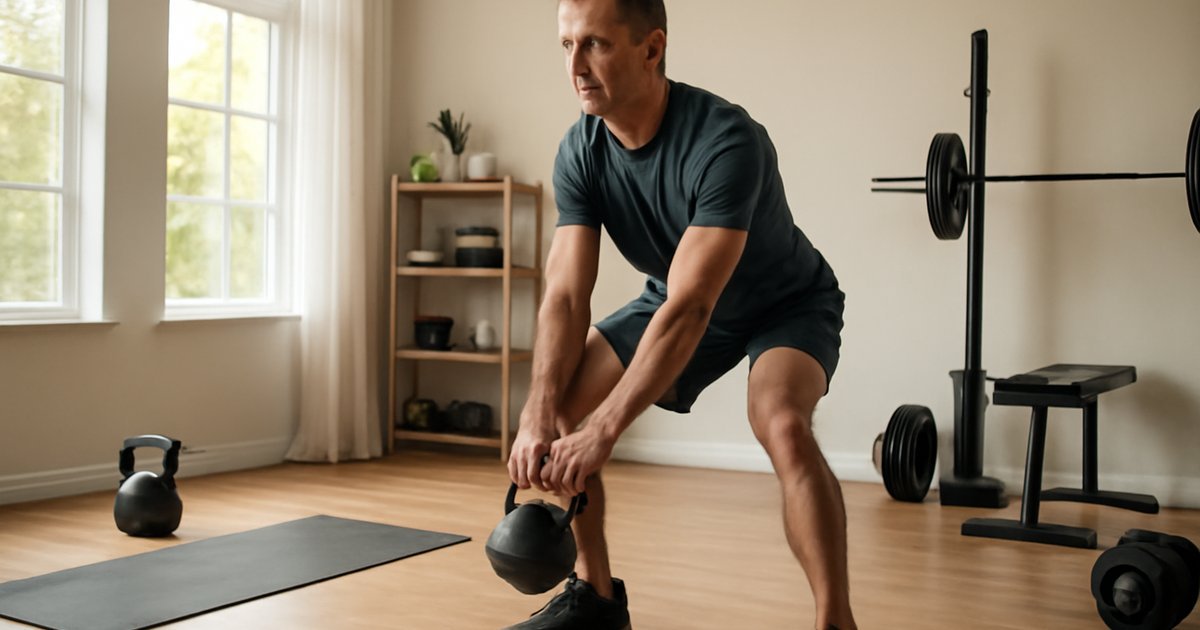
The safest entry point for most beginners. Place the kettlebell between your feet, hinge at the hips, grip the handle, and stand tall by driving through your heels. This teaches the hip hinge pattern that underpins the swing, clean, and snatch.
2. Kettlebell Swing
The signature kettlebell movement. The swing is a ballistic hip hinge — you drive the bell forward using explosive hip extension, not arm strength. It builds posterior chain power (glutes, hamstrings, lower back), improves cardiovascular conditioning, and burns significant calories. Clinical evidence indicates the swing is also beneficial for improving spinal stability when learned correctly.
3. Goblet Squat
Hold the kettlebell close to your chest with both hands and squat to depth. This self-correcting movement naturally promotes an upright torso, making it safer for people with previous back issues than barbell squats. It builds quad, glute, and core strength simultaneously.
4. Single-Arm Press
Pressing a kettlebell overhead with one arm at a time forces your core and obliques to brace and stabilize, building anti-rotation strength — the kind that protects your spine in daily life. Research suggests overhead pressing is one of the most effective movements for shoulder health and upper body strength in older adults.
5. Turkish Get-Up
Often called the most comprehensive single exercise ever designed, the Turkish get-up takes you from lying flat on the floor to standing upright while holding a weight overhead. It trains mobility, stability, coordination, and strength in a single slow, deliberate movement. Many physical therapists use it as a rehabilitation tool. For adults over 40, it also directly trains the ability to get up from the floor — a key predictor of longevity according to research published in the European Journal of Preventive Cardiology.
How to Build Your Kettlebell Routine
Starting too heavy or too fast is the most common mistake adults over 40 make with kettlebells. Most men in this age group should begin with a 16 kg (35 lb) bell for swings and a 12 kg (26 lb) for pressing movements. Most women typically start with 8-12 kg (18-26 lb) for swings and 6-8 kg for presses. That said, this varies significantly from person to person based on training history and current fitness level.
A beginner-friendly weekly structure might look like this:
- Day 1 (Monday): Deadlifts, goblet squats, single-arm press — 3 sets of 8-10 reps each
- Day 2 (Wednesday): Kettlebell swings — 5 sets of 10 reps, Turkish get-up — 3 sets per side
- Day 3 (Friday): Full-body circuit combining swing, goblet squat, and press — 3 rounds
Rest at least one day between sessions. For adults over 50, adding an extra rest day is completely appropriate. Recovery is part of the training. You can complement your kettlebell days with interval walking to boost cardiovascular fitness on off days.
Safety Considerations and Injury Prevention
Kettlebells are safe when used correctly — but that qualifier matters. The ballistic nature of movements like swings and cleans means that poor form amplifies injury risk rather than reducing it.
Clinical evidence strongly suggests that working with a certified kettlebell instructor (look for StrongFirst or NSCA-certified trainers) for at least two to four sessions before training alone significantly reduces injury risk for beginners.
Safety essentials for adults over 40:
- Always warm up for 8-10 minutes before lifting — include hip openers, thoracic rotations, and light cardio
- Never train to failure with kettlebells; stop each set with one to two reps in reserve
- Train on a non-slip surface with adequate space around you
- Listen to your joints: dull muscle soreness is normal; sharp joint pain is a signal to stop
- Progress weight slowly — only when current weight feels completely controlled for all reps
- Keep core braced throughout every movement
Individuals with existing orthopedic conditions — rotator cuff injuries, herniated discs, or severe osteoporosis — should obtain medical clearance before beginning kettlebell training. Most physicians will support the activity once they understand its controlled, hip-hinge-based mechanics.
If you’re also exploring complementary training, our guide on bodyweight training after 40 pairs well with kettlebell work for a balanced program.
Living With a Kettlebell Practice: Long-Term Results
One of the most consistent findings in exercise science is that the best workout is the one you actually keep doing. Kettlebell training has a remarkably high adherence rate among adults over 40 — largely because sessions are short, results are visible quickly, and the equipment footprint is minimal.
Most adults who train consistently with kettlebells for 8-12 weeks report measurable improvements in:
- Resting posture and reduced back pain
- Hip and shoulder mobility
- Cardiovascular endurance
- Sleep quality (linked to resistance training by multiple NIH-funded studies)
- Body composition — reduced fat mass, increased lean muscle
- Confidence in daily physical tasks
A 2020 study published in PLOS ONE found that kettlebell training for 8 weeks produced significant improvements in both physical fitness and quality-of-life scores in adults aged 40-65 — comparable to results seen with traditional gym-based strength training programs requiring far more equipment and time.
Beyond the physical changes, many practitioners report that kettlebell training feels meditative — the focused, rhythmic nature of swings and get-ups demands full mental presence, which research suggests may reduce cortisol levels and improve mood through a mechanism similar to mindfulness-based exercise.
When to Talk to Your Doctor
Before starting any new strength training program, especially if you are over 50 or managing a chronic condition, consulting your primary care physician is the responsible first step. This is not a formality — it’s good medicine.
Schedule a visit before starting kettlebell training if you have:
- Uncontrolled hypertension or recent cardiac events
- A diagnosed spinal condition such as spondylolisthesis or severe disc herniation
- Severe osteoporosis (T-score below -2.5 on a DEXA scan)
- Recent joint replacement surgery
- Unmanaged type 2 diabetes
Seek immediate medical care if during training you experience:
- Chest tightness, pressure, or pain
- Sudden shortness of breath disproportionate to effort
- Dizziness, lightheadedness, or fainting
- Sharp, shooting pain in your spine, shoulder, or knee
- Heart palpitations or irregular heartbeat
These are red flags that require evaluation before continuing exercise of any kind.
Frequently Asked Questions
Is kettlebell training safe for adults with arthritis?
For many people with mild to moderate osteoarthritis, low-impact strength training — including kettlebell work — is actively recommended by rheumatologists. The Arthritis Foundation notes that resistance training reduces joint pain by strengthening the muscles that support affected joints. That said, individual variation is significant. Work with your doctor and a qualified trainer to modify movements as needed, and avoid ballistic exercises during flare-ups.
How heavy should I start with a kettlebell?
Most fitness professionals recommend that beginners prioritize technique over load. Starting lighter than you think you need to — and progressing only when form is flawless — is the consistent advice from certified kettlebell coaches. Attempting to swing too heavy too soon is the leading cause of kettlebell-related lower back strain.
Can kettlebell training replace cardio?
Research suggests it can partially replace steady-state cardio for adults seeking cardiovascular health benefits. High-repetition kettlebell swings elevate heart rate to cardio-training zones (65-85% of maximum heart rate) and produce meaningful aerobic adaptations. However, for adults with specific cardiovascular health goals, most cardiologists recommend a combination of resistance training and dedicated aerobic activity. Discuss your individual targets with your physician.
How soon will I see results from kettlebell training?
Most adults notice measurable improvements in strength, energy, and posture within four to six weeks of consistent training. Body composition changes — visible muscle tone and fat reduction — typically become apparent at eight to twelve weeks. This varies from person to person based on training frequency, nutrition, sleep, and hormonal factors.
Do I need more than one kettlebell?
You can build a complete, effective program with a single kettlebell. As you advance, having two bells of the same weight opens up double-bell exercises, and a lighter bell is useful for pressing while you use a heavier one for swings. Many experienced practitioners own three kettlebells of different weights. But starting with one is entirely sufficient.
Conclusion
Kettlebell training is one of the most time-efficient, evidence-backed, and age-appropriate fitness tools available to adults over 40. In under 30 minutes, three times per week, you can build meaningful strength, improve your cardiovascular fitness, protect your joints, and reclaim the physical confidence that aging can quietly erode.
Michael’s story isn’t unusual — it’s what consistent, intelligent training looks like at 52. The key is starting with proper technique, choosing an appropriate weight, listening to your body, and giving recovery the same respect you give training.
As always, the most important first step is a conversation with your doctor. Bring this information, ask about your individual considerations, and get cleared to begin. Then pick up the bell.
Medical Disclaimer: This article is for informational and educational purposes only. It does not constitute medical advice, diagnosis, or treatment. Always consult your physician or a qualified healthcare provider before making changes to your health routine or treatment plan.
Medically reviewed by our editorial health team. Content follows evidence-based standards aligned with CDC and NIH guidelines.