A simple, low-cost tool that builds strength, protects joints, and keeps you moving — at any fitness level.
Margaret, 63, had been avoiding the gym for two years after a knee replacement. Her physical therapist handed her a set of resistance bands and told her to start there. Six months later, she was stronger than she had been in her 50s — and she never picked up a single dumbbell.
Stories like Margaret’s are increasingly common. According to the National Institute on Aging, adults who engage in regular muscle-strengthening activity at least twice per week have significantly lower rates of disability, falls, and metabolic disease. Yet fewer than 30% of adults over 50 meet that benchmark — often because they believe heavy weights or gym equipment are required.
They are not. Resistance band training for adults over 50 offers a proven, joint-friendly path to building muscle, improving posture, enhancing balance, and supporting long-term independence. This guide explains exactly how to get started, which exercises are most effective, and how to use bands safely as you age.
What Is Resistance Band Training?
Resistance band training is a form of strength exercise that uses elastic bands — available in varying tension levels — to create progressive mechanical load on the muscles. Unlike free weights, bands provide accommodating resistance: the load increases as the band stretches further, matching the natural strength curve of most movements.
Bands come in several forms. Loop bands form a continuous circle and are commonly used for lower-body work. Tube bands with handles allow for pulling and pressing movements similar to cable machines. Flat therapy bands (often used in physical rehabilitation) offer lighter, more controlled resistance.
According to research published in the Journal of Human Kinetics, resistance band training produces muscle activation levels comparable to free-weight training across many upper- and lower-body exercises. This makes bands not just a backup option but a legitimate primary training tool — especially for adults over 50 managing joint concerns, recovering from injury, or working out at home.
The NIH’s physical activity guidelines recommend that older adults perform muscle-strengthening activities for all major muscle groups at least two days per week. Resistance bands make this achievable without a gym membership, heavy equipment, or extensive training experience.
Signs You Could Benefit From This Type of Training
You may be a strong candidate for a resistance band program if you recognize any of the following:
- Joint pain or stiffness — especially in the knees, hips, shoulders, or lower back — that makes weight-bearing exercise uncomfortable
- Recent surgery or injury — bands are commonly used in post-surgical rehabilitation under clinician guidance
- Muscle loss (sarcopenia) — a condition defined by the gradual decline of muscle mass and strength that accelerates after age 50
- Balance concerns — research from the Mayo Clinic suggests that progressive resistance training improves neuromuscular coordination, which directly supports fall prevention
- Low energy or fatigue — regular strength training has been shown in multiple NIH-funded trials to improve mitochondrial function and reduce fatigue in older adults
- Sedentary lifestyle — bands offer a low barrier to entry for adults restarting physical activity after a long break
This varies from person to person, but bands are generally recommended for anyone who wants to build functional strength without the joint stress associated with heavier free weights.
Causes of Muscle Decline After 50 — and Why Resistance Training Matters
After the age of 30, adults begin losing muscle mass at a rate of approximately 3–5% per decade. This process — known as sarcopenia — accelerates significantly after 60. The American College of Sports Medicine estimates that by age 70, many sedentary adults have lost 25–30% of their peak muscle mass.
Several factors contribute to this decline:
- Hormonal shifts — declining levels of testosterone, estrogen, and growth hormone reduce the muscle-building stimulus in older adults
- Reduced protein synthesis — the muscles of older adults are less efficient at building new tissue from dietary protein, a phenomenon called anabolic resistance
- Chronic low-grade inflammation — common in adults with metabolic conditions, this suppresses muscle repair and growth
- Physical inactivity — the most preventable cause; prolonged sitting accelerates muscle atrophy at a measurable rate
- Neurological changes — motor neurons controlling fast-twitch muscle fibers decline with age, reducing strength and reaction time
The encouraging news: clinical evidence indicates that resistance training — even when started in the 60s or 70s — can meaningfully reverse sarcopenia. A landmark study published in the Journal of the American Medical Association found that adults in their 70s who performed progressive resistance training three times per week gained significant muscle mass and functional strength within 12 weeks.
Resistance bands provide exactly the type of progressive mechanical loading needed to stimulate this response — safely and accessibly.
How to Start a Resistance Band Routine: What to Expect
Before starting any new exercise program, particularly if you manage a chronic condition like hypertension, type 2 diabetes, osteoporosis, or heart disease, most physicians recommend clearing it with your primary care provider or cardiologist first. Once you have that green light, the process is straightforward.
Step 1: Choose Your Resistance Level
Bands are typically color-coded from lightest to heaviest. If you’re just beginning, choose a band that allows you to complete 12–15 repetitions of any exercise with good form — meaning the last two reps feel challenging but not painful. Most adults over 50 start with light or medium resistance and progress over 4–8 weeks.
Step 2: Learn the Foundational Movement Patterns
Resistance band training mirrors the same functional movement patterns as free-weight training — push, pull, hinge, squat, and carry. Mastering these basic patterns with a band first builds the motor control and joint stability needed for all daily activities.
Step 3: Establish a Consistent Schedule
Research suggests that two to three sessions per week, separated by at least one rest day, is the optimal frequency for muscle building and recovery in adults over 50. Each session should last 30–45 minutes.
Step 4: Progress Gradually
When a set of 15 repetitions feels easy, it is time to either increase band resistance, add a second set, or slow down the movement tempo (for example, 3 seconds lowering, 1 second lifting). This principle — called progressive overload — is what drives muscle adaptation over time.
Best Resistance Band Exercises for Adults Over 50
The following exercises target all major muscle groups with minimal joint stress. Each one has direct functional carry-over to everyday activities like climbing stairs, carrying groceries, reaching overhead, and getting up from a chair.
Upper Body
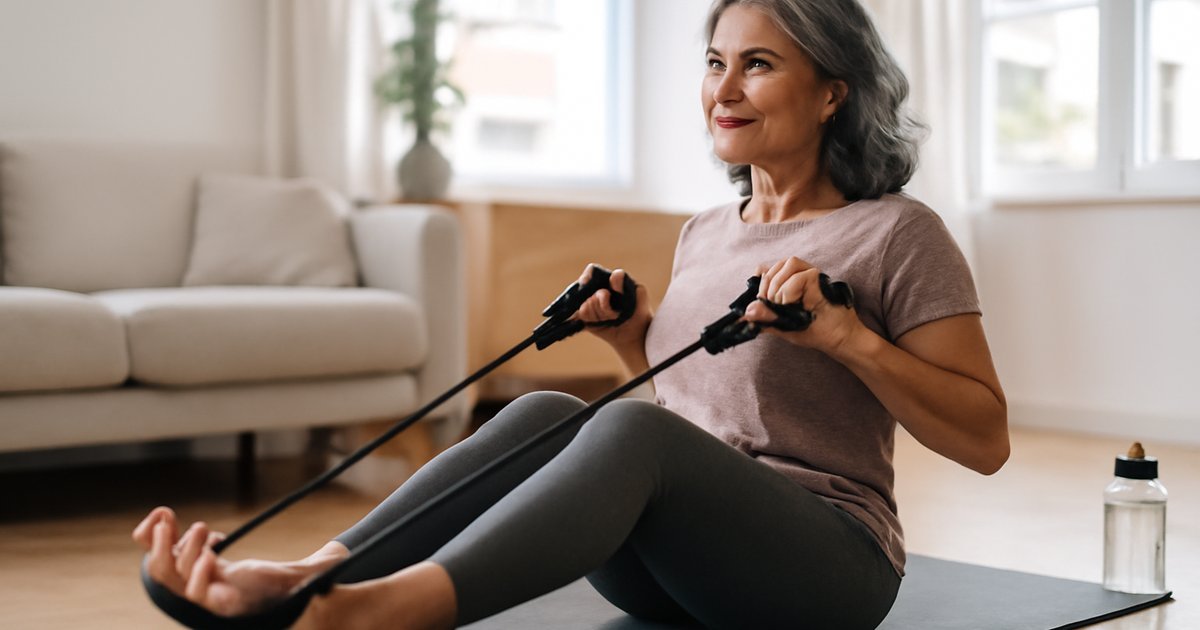
- Seated Row — Sit with legs extended, loop band around feet, and pull handles toward your abdomen. Strengthens the mid-back and improves posture.
- Overhead Press — Stand on the band, hold handles at shoulder height, and press upward. Builds shoulder and triceps strength needed for overhead tasks.
- Bicep Curl — Stand on the band, curl handles toward shoulders. Essential for lifting and carrying capacity.
- Chest Press — Anchor band behind you at chest height, press hands forward. Activates the pectoral muscles and front shoulders.
- Face Pull — Anchor band at face level, pull toward your face with elbows high. A key exercise for rotator cuff health and shoulder stability.
Lower Body
- Banded Squat — Stand on the band with feet shoulder-width apart, hold handles at shoulders, and sit back into a squat. Builds quad, glute, and hip strength critical for fall prevention.
- Glute Bridge with Band — Loop band above knees, lie on your back, and drive hips upward. Activates glutes and hip stabilizers often weakened by prolonged sitting.
- Side-Lying Hip Abduction — Loop band above knees and lie on your side, lifting the top leg. Strengthens the hip abductors, reducing knee and lower-back strain.
- Standing Kickback — Anchor band at ankle height, loop around one ankle, and kick back. Targets the glutes and hamstrings for walking strength and balance.
- Calf Raise — Stand on band with both feet and pull handles up while rising onto toes. Improves ankle stability and reduces fall risk.
For a deeper dive into squat mechanics and progressions specifically designed for older adults, see our guide on Bodyweight Squat Progressions for Adults Over 40.
Living With This Routine: Long-Term Management and Safety
Consistency matters more than intensity — particularly for adults over 50 whose muscles require adequate recovery time between sessions. Here are evidence-backed strategies for making resistance band training a sustainable part of your life:
- Warm up for 5–10 minutes before every session. Light walking, arm circles, or gentle marching in place raises core body temperature and reduces injury risk.
- Cool down and stretch afterward. Clinical evidence from the American College of Sports Medicine indicates that post-exercise static stretching held for 20–30 seconds improves flexibility and reduces delayed-onset muscle soreness.
- Check your bands regularly. Latex bands develop micro-tears with repeated use. Replace any band showing visible cracks, discoloration, or asymmetrical stretching to prevent snapping during exercise.
- Track your progress. Logging sets, repetitions, and perceived effort helps you apply progressive overload consistently and stay motivated.
- Pair training with adequate protein intake. Research suggests adults over 50 benefit from 1.2–1.6 grams of protein per kilogram of body weight per day to optimize muscle synthesis — higher than the standard RDA recommendation.
- Prioritize sleep. Muscle repair occurs predominantly during deep sleep. The NIH recommends adults aim for 7–9 hours of quality sleep per night.
For complementary recovery strategies that support your band training, our article on Foam Rolling After 40: Recovery, Mobility, and Pain Relief provides an excellent evidence-based overview.
If you are interested in expanding your home workout toolkit, you may also find our guide on Aquatic Strength Training After 50 valuable, particularly for days when joints need extra relief.
When to Call Your Doctor — Red Flags and Warning Signs
Most discomfort from resistance band training is normal delayed-onset muscle soreness (DOMS), which peaks 24–48 hours after exercise and resolves within 72 hours. However, some symptoms require prompt medical attention.
Stop exercising and call your doctor if you experience:
- Chest pain, tightness, or pressure during or immediately after exercise
- Dizziness, lightheadedness, or sudden shortness of breath that does not resolve with rest
- Heart palpitations or irregular heartbeat that persist beyond a few seconds
- Sharp, localized joint pain — particularly in the shoulder, knee, or hip — that does not improve within 48–72 hours
- Sudden swelling in any joint, limb, or muscle
- Any loss of sensation, numbness, or tingling radiating down the arm or leg
Call 911 immediately if you experience:
- Chest pain accompanied by sweating, jaw pain, or left arm pain — these are classic warning signs of a cardiac event
- Sudden severe headache with no known cause
- Loss of consciousness, even briefly
At your next routine appointment, mention:
- Any persistent joint soreness lasting more than one week
- Fatigue that does not improve after two or more rest days
- Any changes in blood pressure readings if you are managing hypertension
- Questions about appropriate resistance levels given your specific health history
Frequently Asked Questions
Can resistance bands build real muscle after 50?
Yes. Clinical evidence confirms that progressive resistance training — whether with bands, free weights, or machines — stimulates meaningful muscle hypertrophy (growth) in adults over 50, 60, and even 70. The key is progressive overload: consistently challenging the muscle beyond what it can easily handle. Bands are just as effective as dumbbells for most muscle groups when used correctly.
How do I know which resistance level to start with?
Choose a band that allows you to complete 12 repetitions with good form, where the final two reps feel moderately challenging — not painful or impossible. Most beginners over 50 start with light or medium resistance. If you have joint concerns, starting lighter and progressing slowly is always the safer approach.
Are resistance bands safe if I have osteoporosis?
Research suggests that resistance training, including band-based training, can actually improve bone mineral density in adults with osteoporosis when performed safely. However, individuals with osteoporosis should avoid exercises that involve extreme spinal flexion or twisting, and should work with a physical therapist or physician to design an appropriate program before starting independently.
How quickly will I see results?
Most adults notice improved muscle tone and functional strength within 4–6 weeks of consistent training two to three times per week. Significant changes in muscle size or composition typically require 8–12 weeks. This varies from person to person based on starting fitness level, nutrition, sleep, and training consistency.
Can I do resistance band training if I have arthritis?
For many people with arthritis, resistance band training is actually preferred over free weights because the accommodating resistance reduces peak joint stress. The Arthritis Foundation notes that strengthening the muscles around affected joints can reduce pain and improve joint stability. That said, always check with your rheumatologist or primary care physician before starting — and stop any movement that causes sharp or worsening joint pain.
Conclusion
Resistance band training is one of the most accessible, evidence-supported, and joint-friendly ways for adults over 50 to build the strength their bodies need. Whether you are starting from zero or looking to supplement an existing routine, bands offer genuine results — not as a compromise, but as a proven training system in their own right.
The most important step is the first one. Start with two sessions per week, progress gradually, listen to your body, and keep your physician informed of your activity level and any concerns. Your muscles respond to challenge at any age — and building strength now is one of the most powerful investments you can make in your long-term health and independence.
This article is for informational and educational purposes only. It does not constitute medical advice, diagnosis, or treatment. Always consult your physician or a qualified healthcare provider before making changes to your health routine or treatment plan.
Medically reviewed by our editorial health team. Content follows evidence-based standards aligned with CDC and NIH guidelines.
Leave a Reply