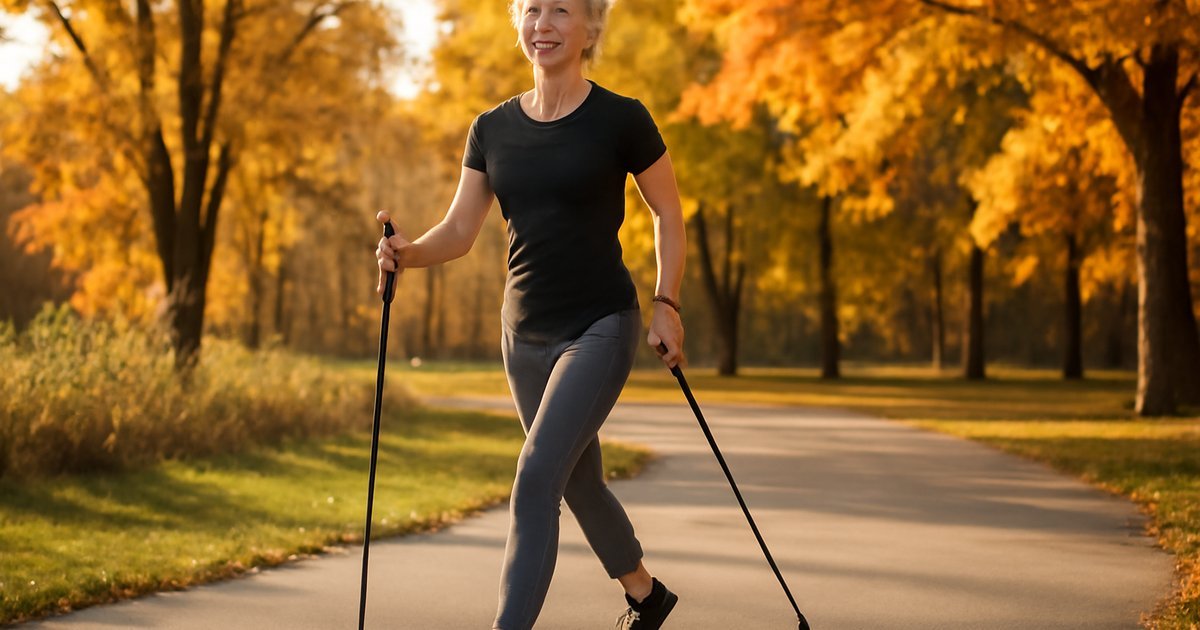
Walking Poles for Fitness After 50: Benefits, Tips & How to Start
Discover how walking poles can transform your daily walk into a full-body workout that protects your joints and builds lasting strength.
Why More Adults Over 50 Are Picking Up Walking Poles
Margaret, 63, had been a dedicated walker for years — until chronic knee pain started making her daily three-mile loop feel more like a burden than a pleasure. Her orthopedist suggested she try walking poles before considering more invasive options. Within six weeks, she was back on the trail, walking farther and with noticeably less discomfort.
Her story isn’t unusual. According to the CDC, nearly 49 million American adults have been diagnosed with some form of arthritis, and joint pain in the knees and hips is one of the most common reasons adults over 50 reduce or abandon regular exercise. That’s a serious public health concern, because physical inactivity dramatically increases the risk of heart disease, type 2 diabetes, osteoporosis, and cognitive decline.
Walking poles — sometimes called trekking poles or Nordic walking poles — offer a practical, low-cost solution that allows you to stay active while protecting vulnerable joints. In this guide, you’ll learn exactly what walking poles are, how they benefit your body, how to choose the right pair, and how to build a safe and effective pole-walking routine — even if you’re starting from scratch.
What Are Walking Poles and How Do They Work?
Walking poles are lightweight, adjustable sticks — similar in appearance to ski poles — used to support and enhance walking. They come in two main forms: trekking poles designed for hiking on uneven terrain, and Nordic walking poles designed for use on flat surfaces with a specific arm-driving technique.
Both types work by transferring a portion of your body weight from your lower body to your arms and shoulders with each stride. This simple mechanical shift does something remarkable: it reduces the load on your knees, hips, and ankles while simultaneously activating your upper body muscles — turning what would be a simple walk into a full-body cardiovascular and muscular workout.
The poles also function as dynamic stabilizers. Every time a pole contacts the ground, it creates an additional point of contact, significantly improving your balance and reducing your risk of stumbling or falling — a critical safety benefit for adults in this age group.
Research published in the Journal of Aging and Physical Activity found that Nordic walking engages up to 90% of the body’s skeletal muscles compared to roughly 40% during regular walking. That’s a substantial increase in muscle recruitment with no additional impact on your joints.
Signs You Might Benefit From Walking Poles
You don’t need to be in poor health to benefit from walking poles — they’re valuable for a wide range of fitness levels and conditions. That said, you may especially benefit if you experience any of the following:
Early to moderate signs that poles may help:
- Mild to moderate knee, hip, or ankle discomfort during or after walks
- A sense of instability or worry about tripping on uneven ground
- Fatigue in your lower back after extended walking
- A desire to increase walking distance or intensity without adding impact
- Recent recovery from a lower-body injury or joint replacement surgery
- Difficulty walking on hills or inclines without losing your footing
More significant signs worth discussing with your doctor:
- Significant balance impairment or a history of falls
- Diagnosed osteoporosis, Parkinson’s disease, or other neurological conditions affecting gait
- Post-surgical rehabilitation where load-bearing is restricted
- Persistent joint pain that limits your current activity level
Clinical evidence from a 2020 meta-analysis in PLOS ONE indicates that Nordic walking is associated with improved functional capacity, balance, and quality of life across multiple patient populations, including those managing chronic musculoskeletal conditions.
Causes of Joint Stress During Walking and How Poles Address Them
To understand why walking poles work so well, it helps to understand what places stress on your joints during a typical walk.
Every time your foot strikes the ground, a force equivalent to approximately 1.5 times your body weight travels through your knee joint. On downhill terrain, that force can spike to three to five times your body weight, according to biomechanical studies cited by the American Academy of Orthopaedic Surgeons. Over thousands of steps, that repetitive loading takes a cumulative toll — especially if you have cartilage thinning, inflammation, or previous injuries.
Several factors increase your personal risk for joint-related walking discomfort:
- Age-related cartilage changes: Cartilage naturally thins and becomes less resilient after 40, reducing its shock-absorbing capacity.
- Excess body weight: Each additional pound of body weight adds roughly four pounds of pressure on the knees with every step, per research from Johns Hopkins Medicine.
- Muscle imbalances: Weak quadriceps and hip abductors shift load distribution unevenly across the joint surfaces.
- Sedentary lifestyle: Paradoxically, reduced activity weakens the muscles that support and protect joints, accelerating deterioration.
Walking poles interrupt this cycle. By actively pushing down and back with the poles as you walk, you offload a measurable percentage of stress from your lower extremities. Studies have shown this offloading can reduce knee compressive forces by 12–25%, which adds up to thousands of pounds of reduced joint stress over a typical one-hour walk.
How to Choose the Right Walking Poles
Choosing the right poles is simpler than it might seem, but a few key decisions will make a meaningful difference in your comfort and results.
Pole Type
For flat sidewalks, parks, and paved paths, Nordic walking poles with angled rubber tips are the best choice. For hiking trails, gravel paths, or uneven terrain, look for trekking poles with carbide or steel tips and optional rubber tip covers for paved surfaces.
Material
Aluminum poles are durable and affordable — an excellent starting point. Carbon fiber poles are lighter and absorb vibration better, which is worth the added cost if you plan to use them frequently or for long distances.
Adjustability
Look for poles with a reliable locking mechanism — either a twist lock or a lever-style flip lock. Adjustable poles let you set the correct height for your body and modify it for uphill or downhill terrain.
Correct Height Setting
The standard rule: when you hold the pole with the tip on the ground, your elbow should be bent at approximately 90 degrees. Most adults find their ideal pole length falls between 100 and 130 centimeters. When walking downhill, lengthen the poles slightly; shorten them for uphill sections.
Grip and Wrist Straps
Cork grips are comfortable for warm conditions and absorb sweat well. Foam grips are softer and gentler on sensitive hands. Wrist straps are important — they allow you to push through the poles without gripping tightly, reducing fatigue and the risk of hand strain.
How to Use Walking Poles Correctly: Technique That Matters
Using poles incorrectly can reduce their benefits and put unnecessary strain on your wrists or shoulders. These technique principles apply whether you’re using Nordic poles on a park path or trekking poles on a trail.
The Nordic Walking Technique (for flat surfaces):
- Hold the poles loosely — thread your hand up through the strap from below so the strap bears most of the load, not your grip.
- Plant the pole at an angle pointing backward, roughly at the level of your opposite foot.
- Push down and back through the pole as you stride forward — this is the engine of the movement.
- Release the pole and let your arm swing naturally forward for the next plant.
- Keep your shoulders relaxed and your core gently engaged throughout.
The Trekking Technique (for trails and varied terrain):
- Plant poles just ahead of your feet for support on uphill sections.
- Plant poles further ahead for braking and control on downhill sections.
- On flat terrain, use a similar opposite-arm, opposite-leg rhythm as in Nordic walking.
- Look ahead, not down — maintain good posture with a tall spine.
It typically takes two to four sessions to feel natural with the technique. Many community recreation centers and outdoor retailers offer brief Nordic walking clinics that can accelerate your learning curve significantly.
Building a Safe and Effective Pole-Walking Routine
The American Heart Association recommends at least 150 minutes of moderate-intensity aerobic activity per week for adults. Pole walking qualifies as moderate-intensity exercise for most people over 50, and its full-body nature means you’re meeting that goal more efficiently than with regular walking alone.
Here’s a practical eight-week progression designed for adults starting with poles for the first time:
Weeks 1–2: Orientation Phase
Three sessions per week, 15–20 minutes each. Focus entirely on learning the technique on flat, familiar ground. Don’t worry about pace or distance.
Weeks 3–4: Foundation Phase
Three to four sessions per week, 20–30 minutes each. Begin incorporating gentle inclines if available. Notice how your upper body is beginning to engage more actively.
Weeks 5–6: Building Phase
Four sessions per week, 30–40 minutes each. Add varied terrain — mild hills, grass, packed gravel. Begin walking at a pace that elevates your heart rate and breathing noticeably.
Weeks 7–8: Consolidation Phase
Four to five sessions per week, 40–50 minutes each. You should now feel comfortable with the technique and notice improvements in endurance, posture, and upper body engagement.
Pair your pole-walking sessions with one or two days of strength training after 50 to build the muscular foundation that makes every walk safer and more efficient. You might also benefit from incorporating flexibility training to maintain the range of motion that good pole technique requires.
Health Benefits Backed by Research
Walking poles aren’t just a comfort tool — they deliver measurable, evidence-backed health benefits for adults over 50.
Cardiovascular improvement: A 2013 study in the European Journal of Applied Physiology found that Nordic walking increased maximum oxygen uptake (VO2 max) significantly more than regular walking, indicating stronger cardiovascular conditioning with no additional joint stress.
Caloric expenditure: Research suggests Nordic walking burns approximately 20–46% more calories than conventional walking at the same pace — a meaningful advantage for weight management.
Upper body strength: Because the poles recruit your triceps, biceps, shoulders, chest, and upper back with every stride, regular pole walking contributes to upper body muscular endurance — an area that traditional walking entirely neglects.
Core stability: The rotational movement of pole walking actively engages the obliques and deep stabilizing muscles of the core. This translates to better posture and reduced low back pain over time — benefits that complement dedicated posture training for adults over 40.
Mental health: A 2019 systematic review published in the British Journal of Sports Medicine found that Nordic walking was associated with significant reductions in depression scores and improvements in overall psychological well-being among adults with chronic conditions — an effect that may be amplified by the outdoor, rhythmic, and social nature of the activity.
Bone density: Because walking with poles is still a weight-bearing activity, it contributes to the mechanical loading that helps maintain bone density — particularly relevant for postmenopausal women at elevated risk for osteoporosis.
When to Call Your Doctor or Seek Emergency Care
Walking poles are generally very safe for healthy adults, but there are situations where you should pause your routine and consult a healthcare provider.
Contact your doctor if you experience:
- New or worsening joint pain that doesn’t resolve within 48 hours of rest
- Shoulder, wrist, or elbow pain after using poles — this may indicate improper technique or an underlying issue
- Dizziness, unusual shortness of breath, or chest tightness during exercise
- Numbness or tingling in your hands, wrists, or arms after pole sessions
- Swelling in any joint following activity
Seek emergency care immediately if you experience:
- Chest pain, pressure, or tightness during or after exercise
- Sudden severe shortness of breath
- A fall resulting in significant pain, inability to bear weight, or visible deformity
- Sudden severe headache, confusion, or vision changes during physical activity
Before beginning any new exercise program, especially if you manage a chronic condition such as heart disease, osteoporosis, or have had recent joint surgery, most physicians recommend a brief consultation to confirm that pole walking is appropriate for your individual situation. This varies from person to person, and your doctor’s guidance takes priority over any general recommendation.
Frequently Asked Questions About Walking Poles After 50
Are walking poles safe if I’ve had knee replacement surgery?
Many orthopedic surgeons and physical therapists recommend walking poles during post-surgical rehabilitation and long-term recovery because they reduce load on the replaced joint and improve balance. However, you should always follow your surgeon’s specific guidance regarding timing and technique before incorporating poles after a joint replacement procedure.
Will walking with poles make me look like I need extra help?
This is one of the most common concerns — and one of the most quickly dispelled once you actually try it. Nordic walking in particular is widely recognized in the US as an athletic fitness activity. You’re far more likely to get curious questions about your workout than sympathetic glances.
How much do good walking poles cost?
Reliable aluminum trekking or Nordic walking poles typically cost between $30 and $80 per pair. Higher-end carbon fiber models range from $100 to $200. For most adults starting out, a mid-range aluminum pair is an excellent investment. Look for brands available at major sporting goods retailers and read verified user reviews before purchasing.
Can I use hiking poles for Nordic walking, or do I need different poles?
You can use standard trekking poles for Nordic walking, but dedicated Nordic walking poles have a fixed wrist strap with a release mechanism that makes the technique more fluid. If you plan to do both activities, adjustable poles with swappable rubber tips are a practical compromise.
How long before I notice the benefits of walking with poles?
Most people begin noticing reduced joint discomfort and improved endurance within two to four weeks of consistent use. Upper body muscle engagement typically becomes noticeable within the first few sessions — many new pole walkers are pleasantly surprised by mild arm and shoulder soreness after early workouts.
Conclusion: One Simple Tool, Lasting Impact
Walking poles represent one of the most underutilized fitness tools available to adults over 50. They’re affordable, accessible, low-tech, and backed by a growing body of clinical evidence. They protect your joints while simultaneously making your walks more demanding, more efficient, and more rewarding.
Whether you’re managing knee arthritis, recovering from injury, trying to stay active on uneven terrain, or simply looking for a way to engage your whole body without adding impact, walking poles offer a practical path forward.
The best step you can take today? Talk to your primary care physician or physical therapist about whether pole walking is right for your specific health profile. Then pick up a pair, head outside, and give yourself the four weeks it takes to feel the difference. Your joints — and your cardiovascular system — will thank you.
Medical Disclaimer: This article is for informational and educational purposes only. It does not constitute medical advice, diagnosis, or treatment. Always consult your physician or a qualified healthcare provider before making changes to your health routine or treatment plan.
Medically reviewed by our editorial health team. Content follows evidence-based standards aligned with CDC and NIH guidelines.
Leave a Reply